There’s a moment in every buying relationship when you stop asking “who has stock today?” and start asking “who will still be reliable six months from now?”
That shift is what separates a one-off purchase from a proper aluminium B2B supplier relationship. The metal is the same. What changes is everything around it: the invoice, the follow-up, the way a problem gets handled when a lot doesn’t match the order.
This guide is for manufacturers, fabricators, contractors and traders in Delhi NCR who buy aluminium regularly and want fewer surprises. We won’t repeat the alloy tables and spec checklists covered elsewhere on our blog. This one is about the business side of buying: how to judge a supplier, what to agree on before the first order, and how to build supply that runs quietly in the background.
What makes an aluminium B2B supplier different from a regular dealer?
A retail counter sells you metal. A B2B aluminium supplier supports a business that depends on that metal arriving, week after week, in the right form.
In practice, the difference shows up in a few places:
- Documentation. Proper GST billing, itemised quotes and delivery papers that match what’s on the truck.
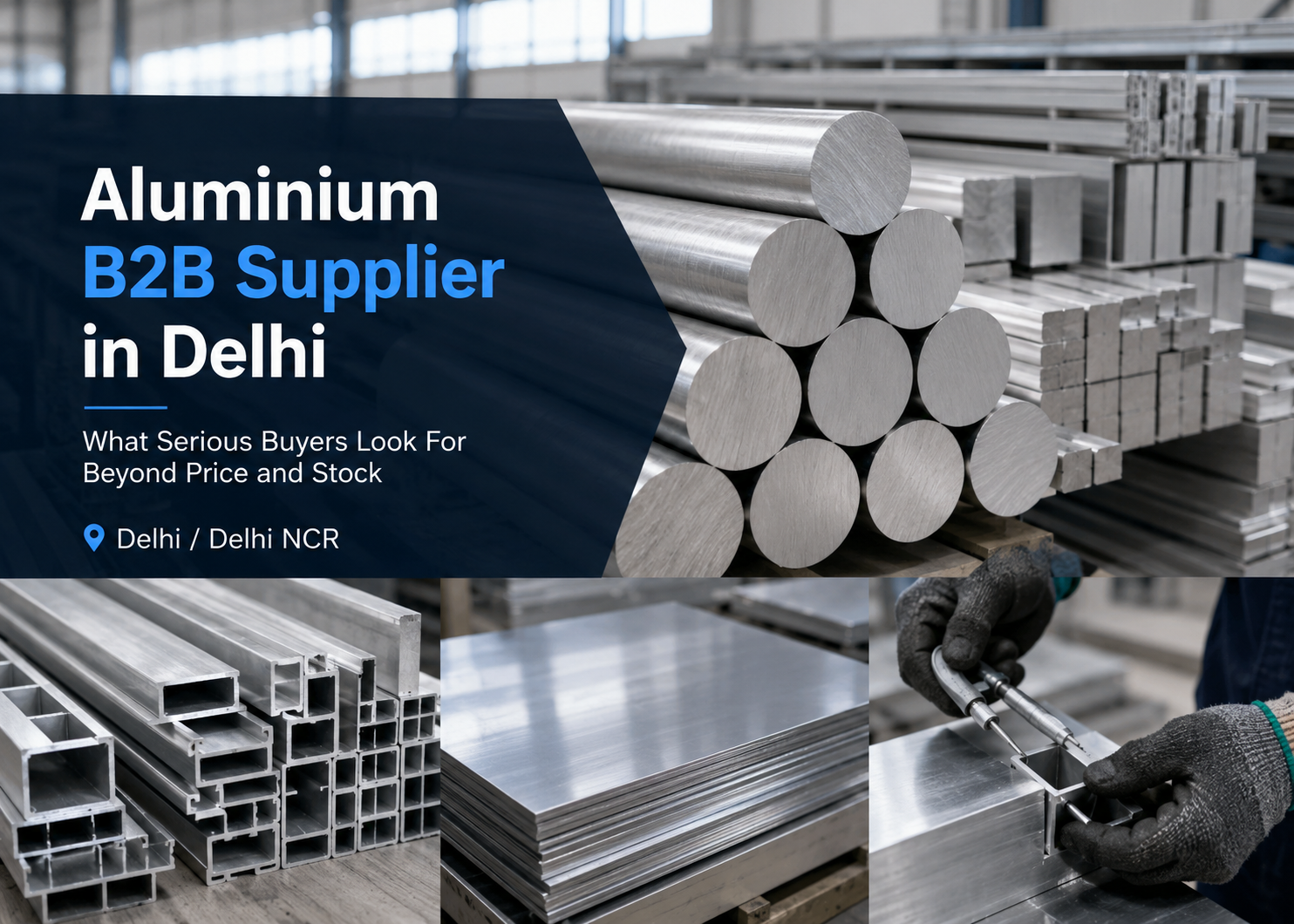
- Range. Rods, flats, pipes, sheets, sections, strips and coils under one roof, so one project doesn’t need four phone numbers.
- Repeatability. The fifth order should look like the first one: same finish, same thickness, same behaviour on the machine.
- Communication. Someone who tells you early when a size is short, rather than the day the truck was supposed to leave.
None of this is glamorous. All of it is what keeps a production line or a site schedule intact.
Who actually needs a dedicated aluminium supplier?
Different buyers worry about different things. Here’s how it usually breaks down:
Manufacturers care most about consistency. If a batch of rods machines differently from the last one, rejection rates rise and nobody knows why. They want the same material, order after order.
Fabricators care about range and speed. A frame job might need sections, flats and sheets together, and a missing piece stalls the whole thing.
Contractors care about timelines and paperwork. Site work doesn’t wait, and inspectors ask for documents.
Dealers and traders care about margins and dependable availability. They resell, so they need a source that doesn’t leave their own customers waiting.
If you recognise yourself in any of these, the next section is the useful one.
A simple scorecard for judging an aluminium supplier in Delhi
Before you commit, run any aluminium supplier in Delhi through this table. You don’t need to score formally. Just notice where the answers feel vague.
| What to check | Why it matters | How to test it |
|---|---|---|
| Clarity on billing and GST invoice | Affects your accounts, input credit and audit trail | Ask how invoices are raised and what details appear on them |
| Range of forms | Reduces the number of vendors you manage | Ask what else they stock beyond your first requirement |
| Willingness to ask about your application | A supplier who asks is matching, not guessing | Notice whether the first question is about use or only about weight |
| Stock visibility | Decides real lead time | Ask what’s ready now and what needs arranging |
| Handling of a mismatch | Every supplier gets one wrong eventually | Ask what happens if size or grade differs from the order |
| Repeat consistency | Protects your production quality | Ask whether a small trial lot can be followed by a larger one |
The fourth and fifth rows tell you the most. Anyone can look good when everything goes right. What you want to know is how they behave when it doesn’t.
Commercial terms to settle before the first order
Most disputes in bulk aluminium supply don’t come from bad metal. They come from terms that were assumed instead of agreed. Sort these out upfront:
- Rate validity. Aluminium prices follow the wider metal market, so a rate quoted today won’t hold for long. Ask how many days a quote stays valid.
- Payment terms. Advance, part payment or credit, whatever the arrangement, put it in writing.
- Minimum quantities. Some forms are sold by weight, others by length or sheet count. Clarify early so you don’t discover it at dispatch.
- Delivery schedule. Single delivery or phased? For larger jobs, phased supply often suits storage better.
- Mismatch handling. If something arrives off-spec, who inspects, how quickly, and what’s the remedy?
Writing these five points down takes ten minutes. It can save weeks of back-and-forth later.
Start small, then scale
Here’s a habit we’d recommend to almost every new buyer: don’t hand a new supplier your biggest order first.
Place a modest trial order instead. Check the material against your drawing, see how it behaves in your workshop, and notice how the supplier handled the process: Was the quote itemised? Did dispatch happen when promised? Did the paperwork match the load?
If all of that goes well, scale up. If something feels off, you’ve lost very little. It’s a low-risk way to find out whether a supplier suits your operation, and honest suppliers don’t mind being tested this way.
Building repeat supply without the stress
Once you’ve settled on a supplier, the goal is to make buying boring.
Share a rough monthly or quarterly estimate of what you’ll need. It doesn’t have to be exact. Even a ballpark helps a supplier hold the right sizes for you. Ask about scheduled deliveries for your fast-moving items. And keep one point of contact on both sides so requests don’t get lost between people.
If you want to see how single-source buying works across different forms, our earlier piece on sourcing aluminium materials from one supplier covers that angle in detail.
Why a Delhi-based supplier still makes sense
WhatsApp and email are handy, but nothing replaces seeing the material yourself. A supplier in Delhi means you can visit, compare stock to your requirement and sort out issues face to face rather than over a chain of messages.
The Ajmeri Gate area has been a metal trading centre in Old Delhi for a long time, and it’s where Ajanta Industries operates from, at Raghushree Market. For buyers across Delhi NCR, including Noida, Gurugram, Faridabad and Ghaziabad, that proximity shortens transit and speeds up decisions.
Matching the product to the requirement
Once the supplier relationship is sorted, the product choice becomes straightforward. If you’re working on machined parts, start with aluminium rods. For panels and enclosures, look at aluminium sheets. For frames and architectural work, aluminium sections are the usual route. You can also browse the full aluminium product range to see how the forms fit together.
Frequently asked questions
What is an aluminium B2B supplier?
It’s a supplier that serves businesses rather than individual retail buyers. That usually means larger quantities, proper GST billing, a wider range of forms and a focus on repeat supply.
How is a B2B supplier different from a trader?
The line can blur, but a B2B supplier is generally set up for ongoing business relationships, with documentation, range and consistency, while a trader may focus on one-off sales. Ask about repeat supply and paperwork to see which one you’re dealing with.
Can a small workshop work with an aluminium B2B supplier?
Yes. Many small fabricators and workshops buy this way. Share your typical monthly requirement and ask what’s workable on quantity and delivery.
How long does it take to qualify a new supplier?
Usually one or two trial orders. By then you’ll have seen the material quality, the paperwork and how the supplier handles follow-up.
Do I need to know the exact alloy before enquiring?
Not necessarily. Describe what you’re making, whether it’s machined, bent, welded or structural, and the supplier can help narrow it down. Always confirm alloy and temper in writing before the order is final.
Final thoughts
A good aluminium B2B supplier isn’t the one with the loudest promise or the lowest number on a quote. It’s the one who answers clearly, documents properly and delivers the same quality on the tenth order as on the first.
If you’re planning regular aluminium purchases in Delhi NCR, share your product, size and quantity with Ajanta Industries through our contact page. Our team will tell you what’s available, what suits your application, and what to expect, and we’ll be upfront if something else would serve you better.