A fabricator once called us after a truck of angles landed at his unit. The size on the invoice matched his order. The angles still wouldn’t hold the frame he’d designed. The thickness was a millimetre lighter than he assumed, and the alloy was softer than he needed. Nobody had lied to him. He had simply ordered by name and not by specification.
This happens far more often than people admit. If you are shortlisting an aluminium sections wholesale supplier, the price per kg is only a small part of the story. What you ask for, and how precisely you ask, decides whether the lot works on your shop floor.
Here are the seven mistakes we see most often, and how to avoid each one.
First, What Counts as an Aluminium Section?
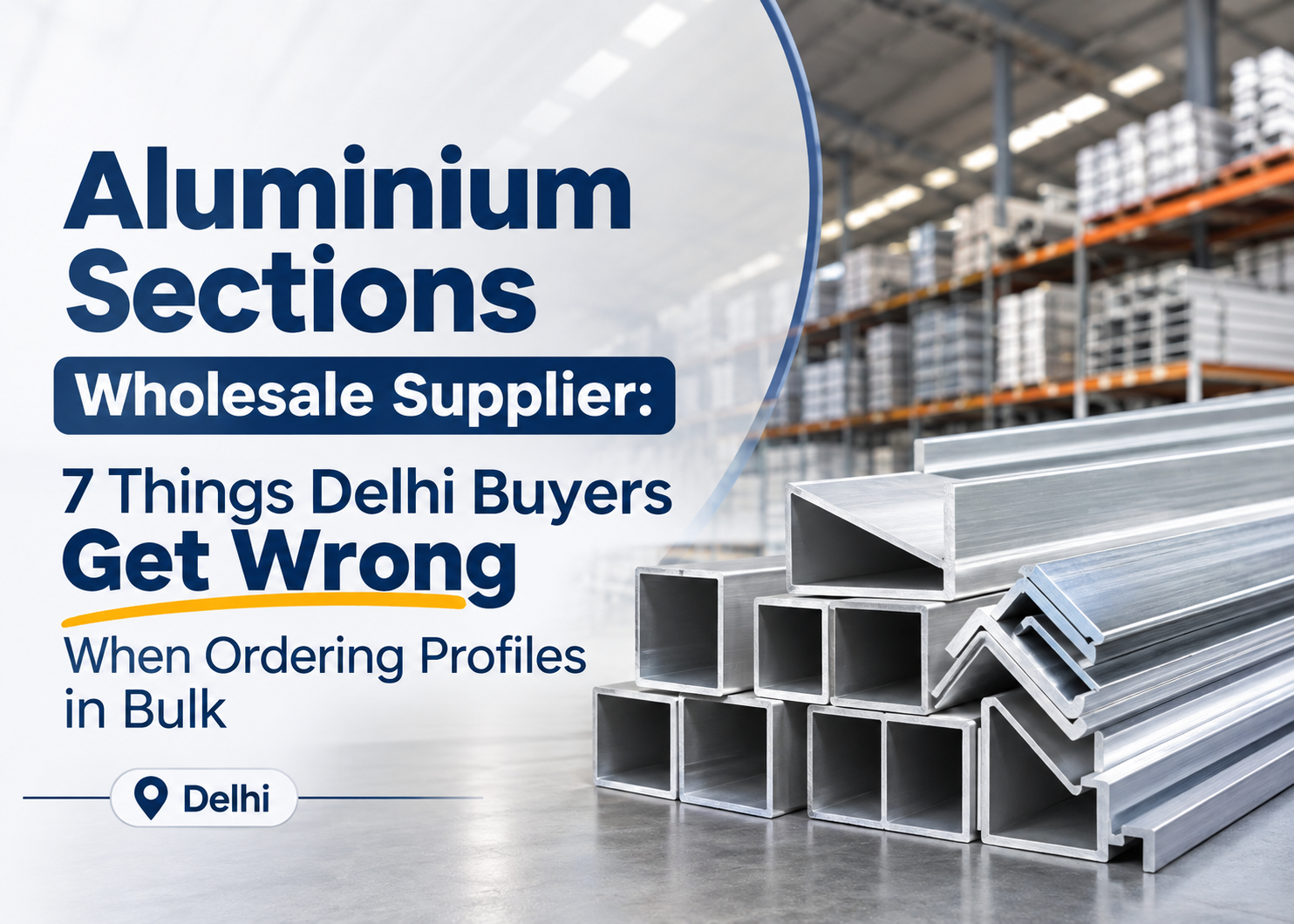
Aluminium sections are extruded lengths with a fixed cross-section. In the trade you will also hear them called aluminium profiles. Common shapes include:
| Section type | Where it is typically used |
|---|---|
| Aluminium angle | Frames, brackets, edge protection, racks |
| Aluminium channel | Guides, tracks, panel supports, trims |
| T-sections | Partition framing, joints, edge trims |
| Hollow (square/rectangular) sections | Light structures, railings, enclosures |
| T-slot profiles | Machine frames, workstations, automation setups |
| Window and door profiles | Architectural glazing and sliding systems |
If your drawing needs something outside these, a custom aluminium extrusion is possible. It comes with its own rules, which we cover under Mistake 7.
Mistake 1: Ordering by Name Instead of Full Dimensions
“50 mm angle” is not a specification. Is it 50 × 50 × 3, or 50 × 50 × 6? Those two weigh and perform very differently.
Always give the full cross-section: leg sizes, wall thickness, and length. For channels, add flange width and web height. A reliable aluminium sections supplier in Delhi will ask you for these anyway. If someone quotes without asking, treat that as a warning sign.
Mistake 2: Skipping Alloy and Temper
Most extruded sections you will see are 6063, often supplied in T5 temper. It extrudes cleanly, finishes beautifully and suits architectural and general fabrication. In Indian standards you may see it written as HE9, which is roughly equivalent.
But 6063 isn’t a universal answer. When the section carries real load, such as machine bases, platforms or structural supports, buyers often move to 6061-T6 or 6082, which are noticeably stronger.
A simple rule from the shop floor: appearance-led work leans towards 6063, load-led work leans towards 6061 or 6082. Tell your supplier what the section will actually do, and let that guide the alloy, rather than guessing a grade name.
Mistake 3: Ignoring Tolerance and Straightness
Extrusions aren’t perfect. Wall thickness, angles and straightness all carry tolerances. On a single piece nobody notices. Across 400 lengths feeding a production line, a bow in the section or a wall that runs thin becomes a real headache.
Ask what tolerance applies and refer to the relevant standard. IS 733 covers aluminium bars, rods and sections for general engineering, and IS 1285 covers extruded tube and hollow sections. For visible architectural work, also ask about surface quality. Die lines and scratches show up fast once a section is anodised.
Mistake 4: Comparing Rates Without Comparing Weight
Two quotes can look different simply because the sections aren’t the same. A slightly thinner wall means less metal per metre, so the rate per kg can look attractive while the section is weaker.
Here’s how to sanity-check it. Aluminium’s density is about 2.7 g/cm³, so:
Weight per metre = cross-sectional area (cm²) × 100 × 2.7 g
Take a 50 × 50 × 5 mm angle. The area is roughly 4.75 cm², which gives about 1.28 kg per metre. If another supplier’s “same” angle comes in at 1.0 kg/m, you’re not looking at the same product.
So when you compare an aluminium sections price, compare it on the same dimensions, alloy, temper and finish. Otherwise you are comparing apples with oranges.
Mistake 5: Assuming the Finish
“Aluminium section” can mean three different surfaces:
- Mill finish is the raw extruded surface. It is fine for hidden frames and further fabrication.
- Anodised gives a harder, corrosion-resistant surface. Architectural anodising typically runs around 15 to 25 microns, so specify the thickness you want.
- Powder coated gives colour options and weather protection, and the coating is usually thicker than anodising.
If sections will be seen by clients, or used outdoors on a coastal project, finish is not a detail to settle later.
Mistake 6: Not Asking for Test Certificates or Checking on Arrival
For industrial and project work, ask for a mill test certificate that records the alloy composition and mechanical properties. It takes a supplier two minutes to share and saves you weeks of dispute.
When the material arrives, do a quick check before you sign:
- Measure wall thickness at a few points with a vernier caliper.
- Check the temper marking and alloy on the bundle tags.
- Roll a few lengths on a flat surface to check straightness.
- Look for transit scratches and dents on the ends and faces.
Fifteen minutes at the gate is cheaper than rejecting a lot after cutting.
Mistake 7: Confusing Standard Sections with Custom Profiles
Standard angles, channels and tubes are available from stock. Custom profiles are different. A custom shape needs a new extrusion die, and that adds tooling cost and usually a minimum order quantity.
So if your design can be adapted to a standard section, it often saves both time and money. If it can’t, plan the lead time. A good bulk aluminium sections supplier will tell you honestly which route suits your volume instead of pushing you towards one.
Why Sourcing Locally in Delhi Helps
Delhi buyers have one real advantage: you can see the material before committing. For a first big order, visit the yard, handle the sections, check the markings and ask your questions across the table. Buyers across Delhi NCR, including Gurugram, Noida, Ghaziabad and Faridabad, use the Old Delhi metal markets for exactly this reason.
It also helps when you need repeat lots. A supplier nearby can deliver in phases, which keeps your cash flow and storage manageable.
A Quick Checklist Before You Send an Enquiry
Keep these ready:
- Section type and full dimensions (with thickness)
- Alloy and temper, or the end use if you are unsure
- Finish: mill, anodised or powder coated
- Length required and quantity
- Delivery location
- Whether you need a test certificate
Send all of this in one message and you’ll get an accurate quote the first time.
Sourcing Aluminium Sections with Ajanta Industries
At Ajanta Industries, we work from Ajmeri Gate, Delhi, supplying aluminium sections along with rods, flats, pipes, sheets, strips and coils to manufacturers, fabricators, contractors and dealers. Many buyers like having several products from one place, especially when a project needs sections and flats together.
If you are ready to enquire, see our aluminium sections wholesale supplier page for the range, or share your requirement on the contact page. You may also want to read our guide on bulk buying aluminium pipes in Delhi and our aluminium sheets spec checklist, as the same ordering discipline applies. For flat-bar requirements, browse our aluminium flats range.
Whatever you order, remember this: the supplier who asks you more questions before quoting is usually the one who gets your order right.
FAQs
What is the most common alloy for aluminium sections?
6063, usually in T5 temper. It suits architectural and general fabrication. For heavier structural use, 6061-T6 or 6082 is often preferred.
Can I get aluminium sections cut to length?
Many suppliers offer cutting. Confirm the length tolerance and whether cutting charges apply before ordering.
How do I compare aluminium sections prices fairly?
Compare quotes on identical dimensions, alloy, temper and finish. Weight per metre is a quick way to spot differences.
Is a custom aluminium profile worth it?
It makes sense for high volumes or a design that no standard section fits. For smaller quantities, a standard section is usually cheaper and faster.
What details should I share to get a quote?
Section type, full dimensions, alloy and temper, finish, quantity and delivery location.