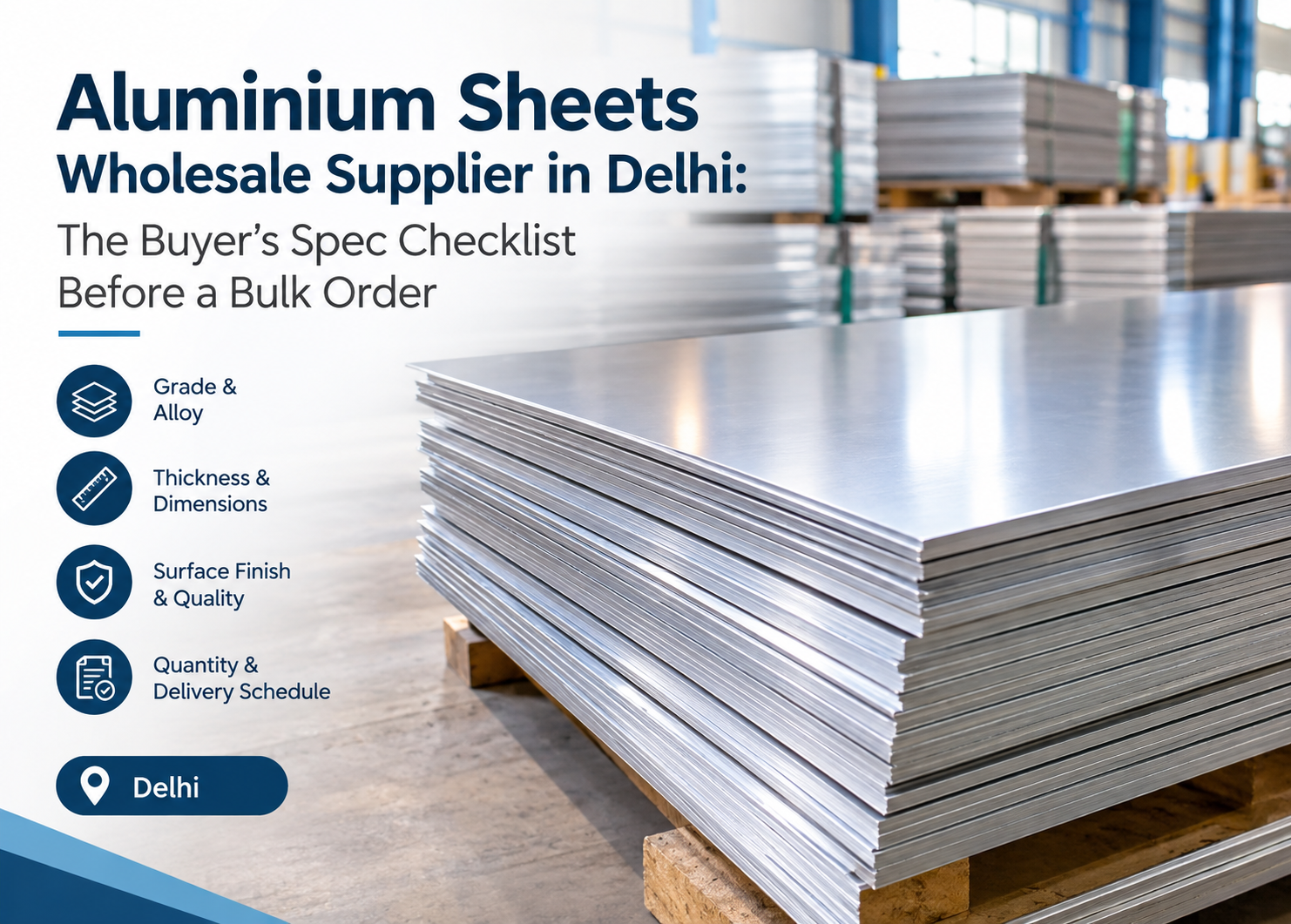
Most bulk aluminium orders go wrong in the same way. The buyer fixes the quantity and the budget, but the specification stays vague. A few weeks later the sheets arrive, and they are too soft for the job, or the finish is wrong, or the thickness is off. That is a costly mistake with metal.
If you are searching for an aluminium sheets wholesale supplier in Delhi, the supplier’s name matters less than whether you know what to ask for. This guide covers the details that decide whether a bulk order works or fails. It is written for fabricators, manufacturers, contractors and dealers.
Why Buyers Prefer Bulk Aluminium Sheets
Aluminium sheets are light, resist corrosion and are easy to cut, bend and form. They go into roofing, cladding, panels, enclosures, tanks, signage and general fabrication. Buying bulk aluminium sheets from a wholesaler instead of retail suppliers usually gives you:
- A steadier per-kg rate on larger quantities
- The same batch quality across a whole project
- One source for matching sheets, flats, strips and sections
- Easier repeat ordering for regular production
Step 1: Choose the Right Alloy
Alloy is the first decision, because it controls strength, formability and corrosion resistance. These four come up most often:
| Alloy | Character | Typical use |
|---|---|---|
| 1100 | Soft, very formable, good corrosion resistance | Utensils, chemical equipment, general sheet work |
| 3003 | Slightly stronger than 1100, good formability | Roofing, cladding, tanks, ducting |
| 5052 | Higher strength, strong corrosion resistance | Enclosures, fuel tanks, marine and transport use |
| 6061 | Heat-treatable, structural strength | Machined parts and structural work |
Not sure which one fits? Tell the supplier what the sheet will do (bend, weld, machine, sit outdoors) rather than guessing an alloy name. A good aluminium sheet supplier in Delhi will help you narrow it down.
Step 2: Don’t Ignore the Temper
Temper tells you how hard the sheet is after processing. It is written after the alloy, as in 5052-H32 or 6061-T6. “O” means soft and annealed, “H” means strain-hardened, and “T” means heat-treated.
Take a deep-drawn part. It needs a soft temper. A rigid panel that must not flex needs a harder one. The aluminium sheet alloy and temper together decide how the metal behaves under your press brake, so confirm both in writing before ordering.
Step 3: Get Thickness and Size Exactly Right
Aluminium sheet thickness is usually quoted in millimetres, though some buyers still use gauge numbers. Check three things:
- Thickness with tolerance. Ask what variation is acceptable. On large orders, small deviations add up.
- Sheet size. Common sizes include 4 ft × 8 ft (about 1220 × 2440 mm) and 1250 × 2500 mm, but availability varies. Confirm before you plan your cutting layout.
- Cut-to-size options. Ordering pre-cut sheets can reduce your wastage.
Step 4: Match the Finish to the Application
- Mill finish is the plain, natural surface, and it suits most fabrication.
- Chequered (tread) sheets give an anti-slip surface for flooring and platforms.
- Coated or anodised sheets are used where appearance and weather resistance matter.
- Protective film helps prevent scratches during handling and transport.
If the sheets will be visible in the final product, ask about surface quality too. Scratches and marks matter a lot in architectural work.
Step 5: Ask for Test Certificates
For industrial and project use, ask for a mill test certificate (MTC) or material certificate. It records the alloy composition and mechanical properties, so you are not relying on someone’s word. Even a small shop can ask for this, and any serious wholesaler should be able to share material details.
Step 6: Understand What Drives the Price
Buyers often ask for an aluminium sheet price without giving a specification, and then the quotes cannot be compared. These factors move the rate:
- Alloy and temper (a 5052 sheet is not priced like 1100)
- Thickness and sheet size
- Order quantity
- Finish or coating
- Global aluminium prices and the rupee exchange rate
So compare quotes only for the same specification. A cheaper rate for a thinner or softer sheet is not a saving.
Step 7: Check Practical Support
Beyond the metal itself, look at:
- How quickly the supplier responds to an enquiry
- Whether they can handle repeat or phased deliveries
- How the material is packed to avoid damage
- Whether they will help with specification questions
Being close to your supplier also helps. Delhi buyers can see material in person before a big purchase, which is a real advantage over ordering blind.
Quick Checklist Before You Send an Enquiry
Keep these ready:
- Alloy and temper (or the end use if you’re unsure)
- Thickness in mm
- Sheet size
- Finish
- Quantity
- Delivery location
With this, a supplier can quote accurately in one go instead of three rounds of emails.
Sourcing Aluminium Sheets in Delhi with Ajanta Industries
At Ajanta Industries, we supply aluminium sheets, rods, flats, pipes, sections, strips and coils to manufacturers, fabricators, contractors and dealers from our base at Ajmeri Gate, Delhi. Buyers across Delhi NCR approach us when they want several aluminium products from one source, with pricing based on their actual specification and quantity.
If you are ready to source, see our aluminium sheets wholesale supplier page for the range, or send your requirement on the contact page. Sharing the checklist details above helps us respond faster and more accurately. You can also explore aluminium flats and aluminium sections if your project needs more than sheets.
FAQs
Which aluminium sheet is best for outdoor use?
xIt varies by product and specification, so share your requirement with the supplier and ask directly.
Which aluminium sheet is best for outdoor use?
3003 and 5052 are common choices because of their corrosion resistance. The right pick depends on the strength you need.
Can I get sheets cut to size?
Many suppliers offer this. Confirm dimensions and tolerance before ordering.
Why do two suppliers quote very different prices?
Usually the specification differs: alloy, temper, thickness or finish. Always compare like for like.