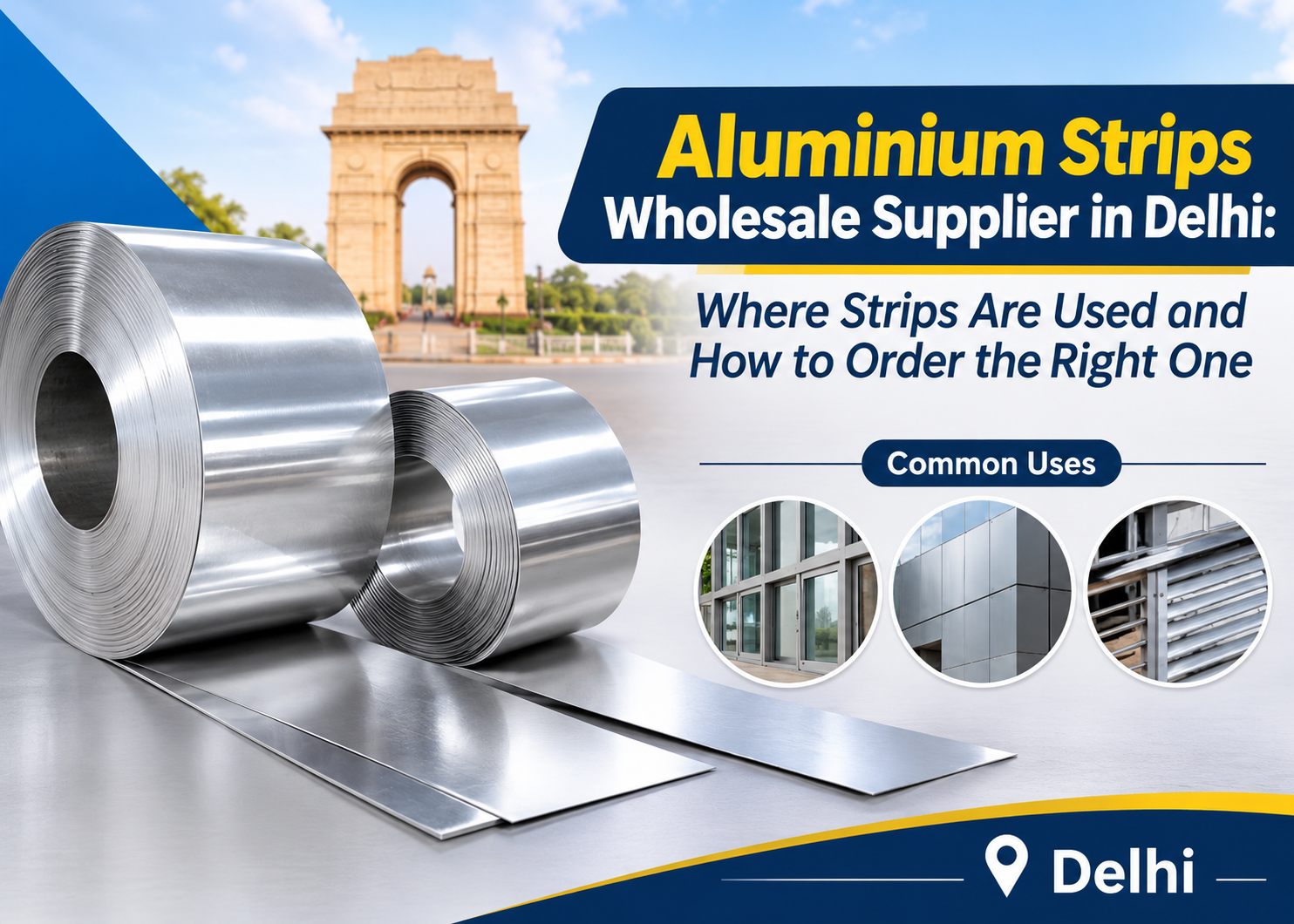
Here’s a small scene that plays out in workshops more often than anyone admits. A buyer orders a few hundred kilos of aluminium strips, the coil or bundle arrives, and the first bend cracks along the edge. Nothing was “wrong” with the metal. It was just the wrong temper for the job.
That’s the kind of mistake a good aluminium strips wholesale supplier helps you avoid. This guide explains where strips are used, what to specify, and how to place a bulk order in Delhi without surprises. It’s written for fabricators, electrical manufacturers, traders and contractors who buy regularly.
What Exactly Are Aluminium Strips?
Aluminium strips are thin, narrow lengths of aluminium, usually supplied in coils or cut lengths. People often mix them up with flats, so here’s a simple way to tell them apart. Strips are generally thinner and lighter, and they’re meant to be bent, punched, wound or formed. Flats are thicker bars used where rigidity matters. If your job leans towards the thicker side, our guide to aluminium flats will help more.
Aluminium weighs roughly 2.7 g/cm³, about a third of steel. It also resists corrosion and works easily, which explains why bulk aluminium strips turn up in so many industries.
Where Aluminium Strips Are Used
Most of the enquiries we hear from Delhi NCR buyers fall into these groups:
- Electrical work: busbars, connectors, earthing strips and winding applications. Aluminium strips for electrical use are chosen for conductivity and low weight.
- Fabrication and trims: edge trims, profiles, brackets and decorative finishing.
- Lighting and signage: reflectors, nameplates and frames.
- Heat management: fins, heat sinks and thermal parts, since aluminium moves heat well.
- General engineering: clamps, spacers, shims and light-duty components.
Each of these needs a slightly different alloy and temper, which brings us to the part most buyers skip.
Grade and Temper: Get This Right First
Grade tells you the alloy. Temper tells you how hard or soft the strip is. Together they decide whether your strip bends cleanly, conducts well or holds its shape.
- 1050 / 1100 series: soft, highly formable and corrosion resistant. Commonly used for general fabrication, trims and thermal parts.
- Electrical conductor grades (such as 1350): chosen when conductivity is the priority.
- 3003: a little stronger than pure aluminium while staying easy to form.
- 5052 / 6061: picked when you need more strength.
For temper, “O” (soft) bends easily, while “H” tempers (such as H14 or H24) are harder and hold their shape better. If your strip will be bent sharply, a softer temper usually saves you from cracking. If it needs to stay rigid, go harder. Always confirm the grade and temper in writing, because “aluminium strip” alone isn’t a specification.
Thickness, Width and Edge: The Three Numbers That Matter
When people discuss aluminium strip thickness, they often stop at one number. Give your supplier all of these:
- Thickness in millimetres
- Width, along with the tolerance you can accept
- Edge condition, such as slit edge or rounded edge, which matters for electrical and visible applications
- Form of supply, meaning coil or cut lengths, plus the quantity you need
A difference of even 0.2 mm changes weight, and over a full order it changes cost too. If your work involves tight fits, ask about tolerance before you commit.
How Aluminium Strip Pricing Works
Almost everyone asks about the aluminium strips price per kg. The honest answer is that there’s no single number. Aluminium is a market-linked metal, so base rates move. Your final rate depends on:
- Alloy and temper
- Thickness and width
- Order quantity
- Any slitting, cutting or processing
- Delivery location
A quote that arrives without any questions about these points deserves a second look. Either the specification wasn’t understood, or the price will change later.
How to Choose an Aluminium Strips Supplier in Delhi
Delhi’s metal market is crowded, especially around Ajmeri Gate, so a quick checklist helps. When you’re comparing an aluminium strips supplier in Delhi, ask:
- Can they name the alloy and temper clearly?
- Will they share a test certificate if your application needs one?
- Can you inspect or sample the material before a big order?
- Is the stock consistent for repeat orders?
- Is the quote itemised and easy to compare?
- Do they ask what you’re making, not just how much you need?
At Ajanta Industries, we’d rather spend five minutes understanding your application than ship a strip that doesn’t suit it. Our team at Ajmeri Gate works with manufacturers, fabricators, contractors and dealers across Delhi NCR, and many of them also pick up aluminium coils or sheets in the same order, which saves coordination time.
Mistakes Worth Avoiding
- Buying on price alone: the cheaper quote often hides a thinner gauge or a different temper.
- Skipping the sample: a small piece tells you a lot about finish and bendability.
- Ignoring wastage: slitting and cutting always leave some loss, so plan a margin.
- Not stating the end use: “for bending” or “for electrical use” helps your supplier suggest the right material.
Ready to Order? Share These Details
To get an accurate quote from an aluminium strips wholesale supplier, keep these ready:
- Alloy and temper (or the end use, if you’re unsure)
- Thickness and width
- Coil or cut length
- Quantity required
- Delivery location in Delhi or NCR
You can see what we supply on our aluminium strips page, and when you’re ready, send your requirement through the contact page.
Frequently Asked Questions
Which aluminium strip grade is best for bending?
Softer grades and the “O” temper, such as 1050 or 1100, usually bend most easily. For stronger parts, a harder temper or a grade like 3003 may suit better.
Can aluminium strips be used for electrical applications?
Yes. Electrical applications typically call for conductor-grade aluminium, so mention this when you ask for a quote.
Do you supply strips in coil form or cut lengths?
Share what you need and our team will confirm what’s available for your size and quantity.
Do you supply outside Delhi?
We work with business buyers across Delhi NCR. If you’re elsewhere, send your enquiry and we’ll discuss what’s feasible.
Final Thoughts
Buying aluminium strips in bulk gets easy once you know four things: the grade, the temper, the thickness and width, and the end use. Get those right, work with a supplier who asks questions before quoting, and the order usually goes smoothly.
If you’re looking for a dependable aluminium strips wholesale supplier in Delhi, share your requirement with Ajanta Industries and we’ll take it from there.



1 Comment
[…] Strips guide […]