Look at the window frame next to you, the aluminium rail on a shop shelf, or the frame of a packing table in a workshop. Chances are good that it started life as a hot, glowing cylinder pushed through a steel die. That, in one line, is what aluminium extrusions are.
If you work in fabrication, construction or manufacturing around Delhi NCR, you probably use extruded material every week. Fewer people stop to ask how it’s made, and that’s a pity. Understanding the process makes it much easier to write a clear requirement and avoid surprises on delivery.
So let’s walk through it in plain terms.
What Are Aluminium Extrusions?
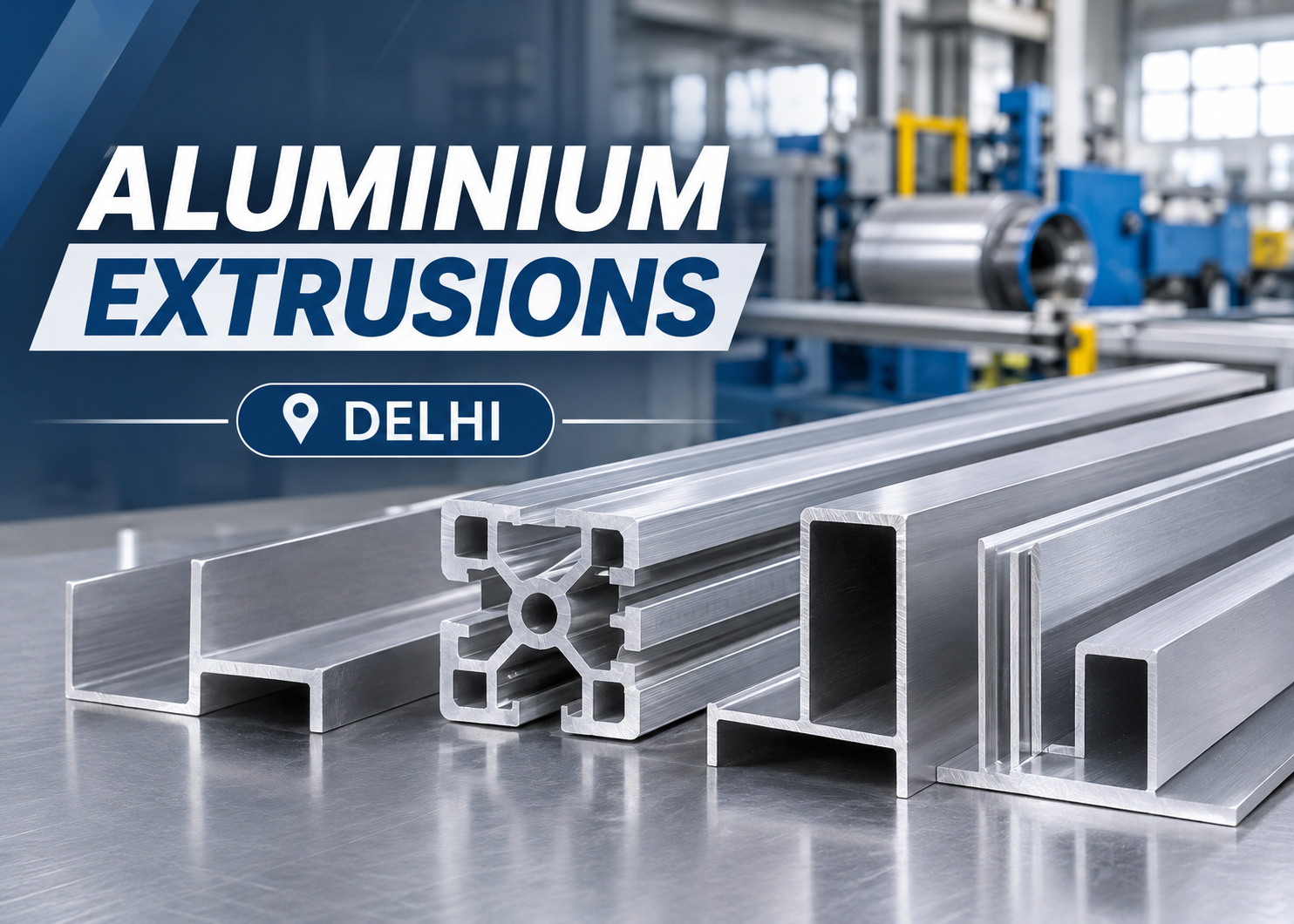
Aluminium extrusions are lengths of aluminium with a fixed cross-section, created by forcing heated aluminium through a shaped opening called a die. Think of squeezing toothpaste out of a tube. The shape of the nozzle decides the shape of what comes out.
The result is often called extruded aluminium or an aluminium extrusion profile. In everyday trade talk, you will also hear the words “sections” and “profiles” used for the same family of products.
What makes this method so popular? One extrusion can have hollow chambers, slots, flanges and thin walls, all in a single piece. That’s difficult and expensive to achieve with other forming methods.
How the Aluminium Extrusion Process Works
You don’t need to run a press to benefit from knowing the steps. Here is the basic flow:
- Billet preparation. A solid cylinder of aluminium alloy, called a billet, is cut to length and heated. For the commonly used 6xxx alloys, this is typically in the range of 400 to 500°C.
- Pressing through the die. A hydraulic ram pushes the softened billet through the die. The metal flows out as a continuous profile.
- Cooling. The profile is cooled by air or water so it keeps its shape and properties.
- Stretching. Long lengths are stretched slightly to straighten them and relieve internal stress.
- Cutting and ageing. The profile is cut to length and, depending on the temper required, aged in an oven to gain strength.
- Finishing. Some profiles stay in mill finish. Others go for anodising or powder coating.
The aluminium extrusion dies are the heart of the whole operation. A standard shape such as an angle or channel uses a die that already exists. A new, unique shape needs a new die, which is why custom profiles carry tooling cost and lead time.
Why Extruded Aluminium Is Everywhere
There’s a reason designers keep choosing it. Aluminium offers a useful mix of properties, and extrusion lets you place the metal exactly where it’s needed.
- Light weight. Aluminium’s density is roughly one third of steel’s, so frames and assemblies are easier to handle and install.
- Corrosion resistance. It forms a natural oxide layer, which helps in humid and outdoor conditions.
- Machinability. It cuts, drills and bends easily, which keeps fabrication time down.
- Design freedom. Slots, channels and hollow sections can be built into the shape itself.
- Low maintenance. A properly finished profile doesn’t need regular painting.
Honest caveat: aluminium is not the answer to every job. For very heavy loads or high-temperature work, other materials may do better. The point is to match the material to the task.
Common Types of Aluminium Extrusion Profiles
Most buyers meet these shapes again and again:
| Profile | Typical use |
|---|---|
| Angles | Frames, brackets, racks |
| Channels | Guides, tracks, panel supports |
| Tubes and hollow sections | Railings, light structures, enclosures |
| T-slot profiles | Machine frames, workstations, automation setups |
| Window and door profiles | Glazing and sliding systems |
| Rods, bars and flats | Machined parts, fabrication, general engineering |
Extrusion also covers solid forms. Many aluminium rods and flat bars are made this way too, which is why buyers sometimes source rods, flats and sections together.
Where Aluminium Extrusions Are Used
Across industries, the pattern is similar: someone needs a strong, light, easy-to-work shape.
- Construction and architecture: window and door systems, partitions, facade elements
- Fabrication and engineering workshops: frames, guards, brackets, jigs
- Manufacturing lines: machine structures, conveyors, workstations
- Commercial fit-outs: display units, shelving, signage frames
- Electrical and panel work: enclosures and supports
Delhi NCR buyers, from Ajmeri Gate to Noida, Gurugram, Ghaziabad and Faridabad, send enquiries across most of these categories.
What to Specify Before You Order
Here’s where a little preparation pays off. Whether you need a standard section or something custom, clear information gets you an accurate quote the first time.
1. A drawing or full dimensions. Cross-section size, wall thickness and length. A name alone isn’t enough.
2. Alloy and temper. Common examples are 6063-T5 for general and appearance-led work and 6061-T6 for stronger applications. If you aren’t sure, describe the end use. Our guide on aluminium sections goes deeper into grade choice and tolerances.
3. Finish. Mill finish, anodised or powder coated.
4. Quantity and delivery location. Order size affects whether a standard or custom route makes sense.
5. Standard or custom. If a ready section does the job, it usually saves time and money. A custom shape makes sense when the design genuinely needs it and the volume justifies tooling.
A handy shortcut for estimating weight: aluminium weighs about 0.27 kg per metre for every 1 cm² of cross-section (based on a density of about 2.7 g/cm³). It’s a fast way to sense-check whether two quotes are really for the same profile.
Standard Extrusions vs Custom Extrusions
| Standard profile | Custom profile | |
|---|---|---|
| Die | Already exists | New die required |
| Lead time | Shorter | Longer |
| Cost | Lower upfront | Tooling cost added |
| Best for | Regular fabrication, smaller lots | Unique designs, high volumes |
When in doubt, ask whether your design can be adapted to an existing section. Often a small design tweak saves weeks.
Quick Quality Checks on Delivery
A few minutes at the unloading bay can save you a lot of trouble:
- Check alloy and temper markings against your order
- Measure wall thickness at a few points
- Look along each length for straightness
- Inspect surfaces for scratches, dents and die lines, especially if you plan to anodise
Sourcing Aluminium Extrusions in Delhi with Ajanta Industries
Ajanta Industries is based at 6, Raghushree Market, Ajmeri Gate, Delhi-110006. We supply aluminium rods, flats, pipes, sheets, sections, strips and coils to manufacturers, fabricators, contractors and dealers. If your project needs extruded profiles alongside other forms, having one point of contact keeps things simple.
Not sure which shape or grade suits your job? Tell us what the part will do, and we’ll help you narrow it down. You can browse our aluminium sections and aluminium rods pages, or read our guide on bulk buying aluminium pipes. When you’re ready, share your product, specification and quantity through our contact page.
Whether it’s a standard profile or a custom drawing, a clear brief gets you a faster, more accurate quote. That’s the habit we’d encourage every buyer to build.
FAQs
1. What is an aluminium extrusion?
It is an aluminium length with a fixed cross-section, made by pushing heated aluminium through a shaped die.
2.Are aluminium extrusions and aluminium profiles the same thing?
In everyday trade use, yes. “Profile” usually refers to the shape of the extruded cross-section.
3.Which alloy is most common for extruded aluminium?
6063 is widely used for general and architectural work, and 6061 is often chosen where more strength is needed.
4.Do I need a custom die for every shape?
No. Standard angles, channels, tubes and flats use existing dies. Only a new, unique shape needs a new die.
5.What details should I share for a quote?
Profile type or drawing, dimensions, alloy and temper, finish, quantity and delivery location.