Two buyers can ask for aluminium coils and end up with very different material. The reason is rarely the metal itself. It is usually a missing detail in the enquiry, such as the alloy, the thickness unit or the coil weight.
This guide covers the basics in plain language: what aluminium coils are, where they are used, how to choose an alloy, and what to share before asking for a quote. It is written for manufacturers, fabricators, contractors and traders in Delhi NCR who want to order with clarity.
What Are Aluminium Coils?
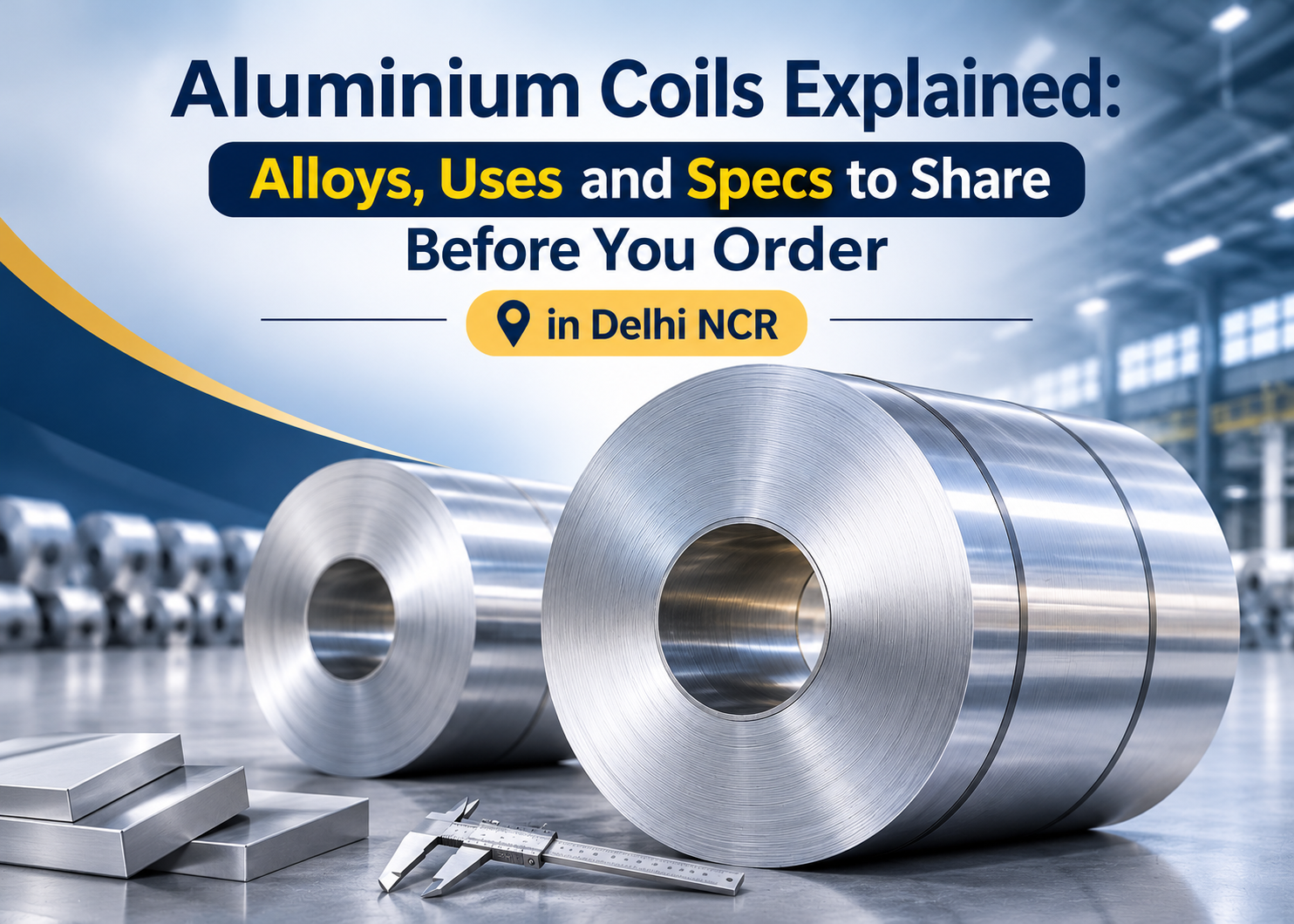
An aluminium coil is aluminium rolled and wound into a continuous roll. Because the material comes in one long length, it suits buyers who need long runs, continuous processing or cut-to-length flexibility, such as roll forming or large production jobs.
Coils are often confused with sheets. A sheet is cut flat to a fixed length, while a coil stays wound. If your job needs flat pieces in set sizes, our aluminium sheets may be the better fit. If you need long lengths of material, a coil makes more sense.
Why Do Industries Use Aluminium Coils?
Aluminium coils are popular because of a useful mix of properties:
- Light weight
- Corrosion resistance
- Good strength-to-weight ratio
- Easy fabrication and machining
- Low-maintenance characteristics
These properties make coils suitable for roofing, cladding, packaging, insulation, electrical applications and general manufacturing.
Choosing the Right Aluminium Coil Alloy
The alloy you pick should depend on what the coil will be used for. Three alloy series come up often in coil enquiries:
- 1xxx series (for example 1050 and 1100): Soft, highly formable and corrosion resistant. These suit packaging, fins and general forming work.
- 3xxx series (for example 3003): Stronger than the 1xxx group. Commonly used for roofing, cladding and gutters.
- 5xxx series (for example 5052): Adds more strength and resistance to harsher environments.
Do not choose by alloy name alone. Start with the end use, then match the alloy to it. If you are not sure, tell the supplier what you are making and ask for guidance.
Alloy is only half the picture. The temper of the coil also affects strength, corrosion resistance and workability, so always confirm both alloy and temper before ordering.
Thickness, Width and Finish: Details That Change the Quote
Aluminium coil thickness is often quoted in millimetres, but some buyers and sellers use gauge. A number without a unit invites confusion, so write “0.8 mm” rather than just “0.8”.
Width, coil weight and the inner diameter of the coil also need to be stated, along with the surface finish you want. Each of these can change what is supplied and what it costs, so leaving them out usually leads to follow-up calls and delays.
How to Estimate Coil Length from Weight
Here is a quick way to turn weight into running length. Aluminium has a density of about 2.7 g/cm³, so:
Weight per metre (kg) = width (m) × thickness (m) × 2700
Take a coil that is 1250 mm wide and 0.8 mm thick:
- 1.25 × 0.0008 × 2700 = 2.7 kg per metre
- A 1,000 kg coil would hold roughly 370 metres of material
Treat this as an estimate for planning and for comparing quotes on equal terms, not as an exact figure.
What to Include When You Ask for a Quote
Send these aluminium coil specifications together in your first message:
- Alloy and temper
- Thickness (with unit)
- Width
- Coil weight and inner diameter
- Surface finish
- Quantity
- End use
If you are unsure about the grade, simply mention the end use and ask for help narrowing it down.
Do You Need the Coil Slit or Cut?
Many buyers need coils processed to a specific width or length before use. If that applies to you, say so at the start. Mention the width you need, the tolerance you can accept and the quantity, so that what can be supplied is confirmed before you place the order rather than after.
Quick Checklist Before You Enquire
- Is the alloy matched to the application?
- Have you stated the temper?
- Is thickness written with its unit?
- Do you know the width, coil weight and inner diameter?
- Have you mentioned any slitting or cut-length need?
Sourcing Aluminium Coils in Delhi
Ajanta Industries is based at 6, Raghushree Market, Ajmeri Gate, Delhi-110006. We supply aluminium rods, flats, pipes, sheets, sections, strips and coils to manufacturers, fabricators, contractors, dealers and commercial buyers. For buyers who need aluminium raw material in more than one form, sourcing from a single place means fewer vendors to follow up with.
You can see our full aluminium coils page, or read our related guides on aluminium strips and the aluminium sheets buyer’s checklist if you are comparing forms.
Ready to share your requirement? Send your product, specification and quantity through the contact page, or call the team at Ajanta Industries on 9999355566, 9313102300 or 9717181173.
FAQs
1. What is the difference between an aluminium coil and an aluminium sheet?
A coil is aluminium rolled and wound into a continuous roll, while a sheet is cut flat to a fixed length. Coils suit long runs and continuous processing, and sheets suit smaller, one-off pieces.
2. Which alloy series are common for aluminium coils?
1xxx series such as 1050 and 1100 are soft and formable. 3xxx series such as 3003 are stronger and used for roofing, cladding and gutters. 5xxx series such as 5052 add strength and resistance to harsher environments.
3. How can I estimate the length of metal in a coil?
Multiply width (m) × thickness (m) × 2700 to get kg per metre, then divide the coil weight by that figure.
4. What should I mention when ordering coils?
Alloy, temper, thickness, width, coil weight, inner diameter, surface finish, quantity and end use.